

“Womanist is to feminist as purple is to lavender.”
— Alice Walker, In Search of Our Mothers’ Gardens (1983)Lately, I’ve found myself in conversations that seem simple on the surface but reveal something much deeper underneath.
The original question I posed was straightforward: If a woman says that if her relationship ends, she’s perfectly comfortable with the father becoming the primary parent while she moves on with her life — what does that tell us about how she views motherhood?
I expected a discussion about parenting, responsibility, sacrifice, commitment, and the child. Instead, the conversation quickly became about women’s agency. And that’s when I realized the real question wasn’t about custody at all.
It’s about whether modern conversations still allow us to separate motherhood from womanhood.
Understanding the Rise of Womanism: The Framework Behind the Conversation

To understand why every conversation about motherhood seems to collapse into a conversation about women’s freedom, we need to understand the intellectual tradition that shaped it — Womanism.
Alice Walker coined the term “womanist” in 1979 and expanded it in her 1983 essay collection In Search of Our Mothers’ Gardens: Womanist Prose. Womanism emerged from the recognition that mainstream feminism of the 1960s and 70s routinely overlooked Black women in favor of issues affecting primarily middle-class white women.
Walker defined a womanist as a Black feminist or feminist of color — one committed to the survival and wholeness of entire people, both women and men. Not a branch of feminism. A broader liberation — one that holds race, gender, spirituality, community, and love all at once.
As Walker famously wrote: “Womanist is to feminist as purple is to lavender.” Same family. Different depth.
This is the tradition that gave Black women language for our full humanity. And it is beautiful. It is necessary. It is ours.
But here is where I want to invite a honest conversation inside this tradition: Womanism, at its core, was never meant to exempt mothers from the weight of motherhood. Walker’s definition explicitly includes responsibility, seriousness, and being “in charge.” The womanish girl is not the girl who walks away — she is the one who shows up, fully and without apology.
When we invoke women’s liberation to avoid conversations about maternal responsibility, we may be borrowing the language of Womanism while leaving its deepest commitments behind.
- How has the Womanist tradition shaped how you understand yourself as both a woman and a mother?
- Is there a difference between reclaiming your autonomy and releasing your responsibilities?
- What does “wholeness” mean for you — does it include your children, or is it defined apart from them?
The Choice Before the Choice: What Motherhood Actually Introduced
For most of my life, I wasn’t a mother. I had my first, only, and likely last child at 33. For over three decades, I lived entirely in the world of womanhood — my goals, my dreams, my healing, my relationships, my career, my freedom.
Then I became a mother.
And whether people like it or not, motherhood changed the way I view nearly everything. Not because I lost my identity. Not because I stopped being a woman. But because another human being now exists whose well-being is directly connected to decisions I make every single day.
Motherhood introduced a layer of responsibility that womanhood alone never required of me.
That is not oppression. That is the nature of parenthood. The same applies to fathers. The moment we bring a child into the world, we step into an obligation that extends beyond ourselves — and that extension is not a cage. It is a calling.
Dr. Amber Tucker, a teaching assistant professor at Marquette University whose research centers on identity development among Black women and Black motherhood, writes that “becoming a Black woman involves continual adaptations to temporal and historical contexts” — and that Black motherhood is a contested space, deeply shaped by the histories Black women carry into it. The complexity is real. The weight is real. And still — the child is real.
- When did you first feel the shift — the moment where your decisions stopped being only about you?
- Have you ever confused releasing old wounds with releasing maternal responsibility? What was that like?
- What did your own mother’s presence or absence teach you about what a child needs?
When Women’s Advocacy Becomes a Way to Avoid Hard Questions

One commenter suggested that women publicly discussing their willingness to let fathers become primary parents is evidence of women embracing agency. Maybe she’s right. Maybe it is. But I couldn’t help noticing that the conversation stopped there.
The discussion became centered on the mother’s freedom rather than the child’s experience. The mother’s choice rather than the child’s dependency. The mother’s autonomy rather than the responsibilities that come after exercising that autonomy.
And that’s where I found myself asking: Can we take the woman-advocacy hat off for a moment and put on the mother hat? Not forever. Just long enough to ask a different set of questions.
This isn’t about returning to suffering. It’s about refusing to let the language of liberation become a language of escape.
Dr. Crystasany R. Turner, Assistant Professor of Teacher Education at the University of Wisconsin-Milwaukee, co-edited a landmark collection on Black motherscholars, arguing that Black women navigate both oppressive systems and deep maternal identities simultaneously — not by choosing one over the other, but by holding both with intention. That holding is the work.
- Has defending your autonomy as a woman ever made it harder for you to examine your choices as a mother?
- Where did you learn that your needs and your child’s needs were in opposition?
- What would it look like to advocate for yourself and stay fully committed to your child?
What Black Feminist Scholarship Says About Separating the Two
The tension between womanhood and motherhood is not new to Black feminist thought. In fact, some of our most powerful scholars have spent entire careers examining exactly this intersection — not to dissolve it, but to deepen our understanding of it.
Author of Black Feminist Thought (1990), Collins introduced the concept of “othermothering” — the practice by which Black women extend maternal care beyond biological children into the community. For Collins, Black mothering was never simply private. It was always also political.
Read More →Her research on embodied Black womanhood finds that Black girls’ journeys toward becoming Black women are shaped by “constrained and liberatory choices” — and that motherhood is a contested, formative space in that becoming.
Read the Research →Co-editor of Black Motherscholarship Within and Beyond the Academy, Turner centers the idea that Black women’s maternal identities are acts of resistance — not constraints to overcome, but creative, revolutionary expressions of presence.
Explore the Book →The architect of Womanism never positioned Black women’s liberation as a rejection of maternal love. Her Womanist definition includes being “committed to survival and wholeness of entire people” — including our children.
Learn About Womanism →- Which of these scholars speaks to something you’ve already been feeling but couldn’t name?
- How does the concept of “othermothering” challenge or expand your view of what motherhood can look like?
- Is your maternal identity something you’ve been taught to minimize? Where did that come from?
Womanhood and Motherhood Are Not Enemies — But They Are Not the Same
Let me be clear about what this conversation is not.
This is not an argument against women’s rights. It’s not an argument for traditional gender roles. It’s not an argument that mothers should suffer endlessly for their children.
The problem is that we’ve become so accustomed to defending women that sometimes we struggle to discuss motherhood without immediately viewing every question as an attack on women.
A woman can choose whether she wants to become a mother. But once that child arrives, motherhood introduces obligations that extend beyond the self. That isn’t oppression. That’s the nature of parenthood — and it applies equally to fathers.
You are still a woman inside your motherhood. Your healing still matters. Your dreams still matter. Your identity outside of your children is worth protecting. And — your presence in your child’s life matters in ways that cannot be easily substituted, no matter how capable the other parent is.
Both things can be true.
- Do you feel like you have to choose between being a whole woman and being a present mother?
- What false choices have you been given about your identity that you’re still sorting through?
- What does it look like when a woman fully owns both — her womanhood and her motherhood — without apologizing for either?
The Question I’m Still Sitting With

Perhaps the most surprising thing about this conversation wasn’t the disagreement. It was the resistance. The inability to even sit with the question without immediately shifting the focus back to adult autonomy.
That made me wonder: Have we become so focused on protecting womanhood that we’ve lost the language to discuss motherhood on its own terms?
I don’t have the answer. I’m still working through it myself.
What I do know is that becoming a mother at 33 felt like stepping into an entirely different world. A world where the questions became more complicated. A world where the needs of another human being entered every equation. A world where sacrifice, responsibility, love, identity, freedom, and commitment all began competing for space.
Maybe that’s why this conversation struck a chord with me. Because I’m not just trying to understand women. I’m trying to understand mothers.
And perhaps those are not always the same conversation.
- When you imagine the woman you are becoming — is your child in that picture? How?
- What is one thing you know your child needs from you specifically that no one else can give?
- What would it mean to fully, freely, joyfully own the word “mother” — not as a limitation, but as one of the most powerful things you’ve ever become?
Frequently Asked Questions
Absolutely not. Healing is not selfish — it is foundational. A woman who has done her inner work is a more present, more attuned mother. This post is about ensuring that the pursuit of healing doesn’t become a permission slip to walk away from the weight of motherhood. Both are possible. Both are necessary.
Womanism is a liberation framework coined by Alice Walker in 1983, rooted in the lived realities of Black women. Where mainstream feminism often centered the experiences of white, middle-class women, Womanism centers race, gender, spirituality, and community together. Walker described it as “womanist is to feminist as purple is to lavender” — same family, much deeper hue.
Yes — and she should. Your children are not your whole identity. You had a self before them, and nurturing that self makes you a healthier mother. The question this post raises is not whether you have an identity beyond your children, but whether you’re using that identity as a reason to minimize your commitment to them.
Othermothering, a concept developed by sociologist Patricia Hill Collins, refers to the tradition in Black communities where women extend maternal care to children who are not biologically theirs — through mentoring, communal care, and active presence. It challenges the narrow, nuclear-family idea of motherhood and reveals that Black women have always understood mothering as a communal, expansive act of love.
Across Scripture, maternal love is used as one of the most powerful images of God’s character. Proverbs 31, Isaiah 66:13, and the witness of women throughout the Bible all point to something sacred in the mother-child bond. Faith doesn’t require mothers to suffer — but it does call us toward covenant. Toward showing up even when it’s hard. Toward a love that doesn’t walk away.
No. This is a reflective space for any woman who has ever felt the tension between who she is and who she is as a mother. Whether you’re single, partnered, thriving, or struggling — if this post stirred something in you, that stirring is worth sitting with. That’s what The Circle of Becoming is for.
Further Reading: Books for the Journey
If this post opened something in you that wants to go deeper, here are books that have shaped the conversation — from the library of The Circle of Becoming.
The foundational text of Womanism. Walker names a tradition Black women had lived for generations but never had language for. Essential reading for any woman trying to understand the roots of modern conversations about Black women’s liberation and identity.
Collins introduces othermothering, standpoint theory, and the outsider-within — concepts that transform how we understand Black women’s roles in family and community. A scholarly but deeply personal text that every woman in this community should know.
hooks argues that the women most marginalized by mainstream feminism — Black women, poor women, mothers — should be its center, not its afterthought. Her lens on love, power, and self-determination speaks directly to the questions this post raises.
The most devastating, most beautiful literary meditation on Black motherhood ever written. Morrison does not let us look away from what it means to love a child in a world that threatens that child’s humanity. Read it slowly. Read it twice.
Harris-Perry examines the crooked room Black women are forced to stand in — how stereotypes of the Strong Black Woman, the Welfare Queen, and the Mammy distort how we see ourselves and how others see us. Profoundly relevant to conversations about Black mothers and choice.
Roberts documents the long history of state violence against Black women’s reproductive lives. Understanding this history is essential context for any conversation about Black mothers, choice, and the structures that shape our decisions.
A guided journal rooted in faith and intentional living, for women who are in the process of becoming. If you’re working through questions of identity, purpose, and who God is calling you to be — this was written for you.
This Conversation Belongs in Community
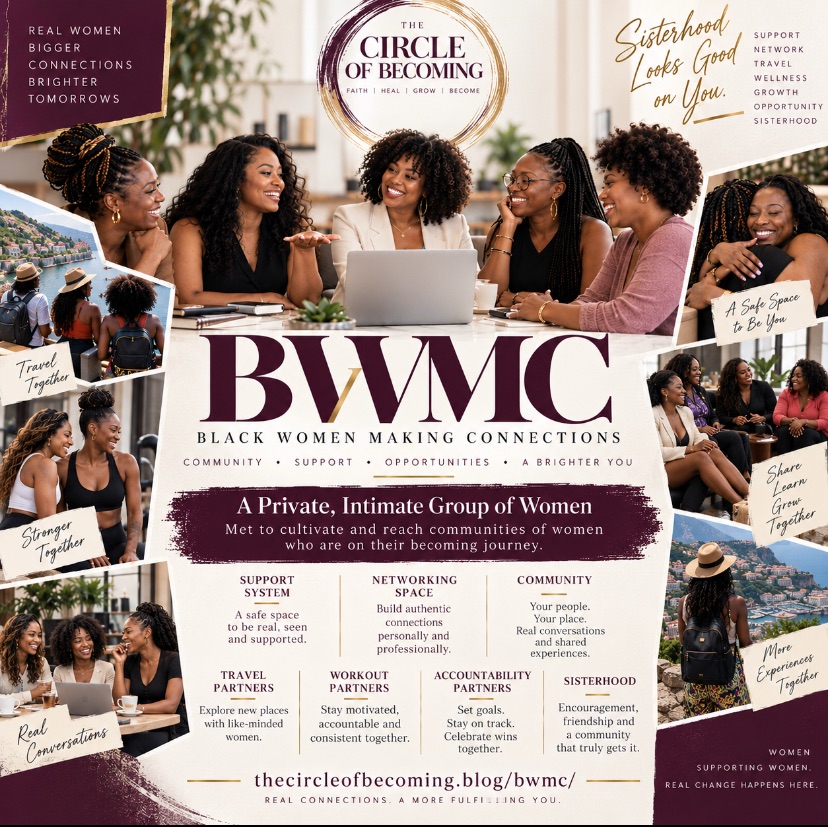
You don’t have to sit with these questions alone. The Circle of Becoming is a space for women doing this exact kind of honest, tender, complicated inner work. Come be with us.
Join The Circle →


Leave a Reply