

Raising Sons, Protecting Daughters, and Healing the Wounds We Inherited
Anxiety is something everyone seems comfortable admitting they have.
But can we talk about what it actually feels like to live with it?
The easiest way I’ve ever explained anxiety is through a storm.
A twister forming in the distance.
At first it looks manageable. Small even.
But slowly it begins pulling everything into its path.
Finances. Parenting. Your health. Your child’s safety. Work responsibilities. The pressure to hold everything together.
One minute you’re managing.
The next minute everything feels like it’s spinning.
And once I became a mother, that feeling intensified in ways I wasn’t prepared for.
But not just motherhood.
Black motherhood.
Because parenting while Black carries a weight that people outside the experience don’t always see.
Understanding the Storm: What Black Maternal Anxiety Actually Looks Like
Storms don’t just appear out of nowhere. They build.
Layer by layer. Pressure by pressure.
And for many Black mothers, anxiety isn’t just one issue. It’s a storm made up of many different pressures spinning at the same time.
Layer One: Intergenerational Trauma and Generational Wounds
Many of us are raising children while still healing from the environments we grew up in.
Favoritism. Colorism. Gender bias. Parentification. Emotional neglect. Abuse.
Some of us learned survival before we ever learned safety.
Those experiences don’t disappear when we become adults. They follow us into our relationships. Into our parenting. Into the quiet anxiety of trying to give our children something we never fully received ourselves.
This is what intergenerational trauma looks like in real life , not just in therapy offices, but in the choices we make, the fears we carry, and the cycles we’re desperately trying to break.
A 2023 study in the Journal of Marital and Family Therapy found that Black communities experience traumatic events at a higher rate than other racial groups, and examined how historical trauma, race-based trauma, and intergenerational trauma compound those experiences.
Layer Two: The Unique Pressure of Black Motherhood

Something shifts the moment you become a mother. Your heart now lives outside of your body.
All you want to do is protect your child and give them the best life possible given your circumstances.
But society adds another layer of pressure onto Black mothers specifically.
Parenting while Black can feel political. Every decision feels scrutinized. Every mistake feels amplified. Every success still feels like it needs explanation.
And if you grew up without healthy motherhood modeled for you, the pressure multiplies.
Because now you’re not just raising a child. You’re learning how to be the mother you needed while raising the child who needs you.
Layer Three: Raising Black Daughters, Love, Pressure, and the Weight We Pass Down
But the conversation doesn’t stop with motherhood itself. It continues with how we raise our children.
And daughters carry their own weight in this storm.
In many Black households, it’s no secret that girls are often raised harder than boys. Girls are expected to mature faster. Be responsible earlier. Handle more emotionally.
Sometimes daughters are pushed to become the best version of themselves. But sometimes that push turns into pressure. Sometimes it turns into mothers trying to live through their daughters. Sometimes it turns into jealousy.
These are uncomfortable conversations, but they exist.
Many daughters grow up feeling like they had to earn love through performance. Be the good girl. Be the responsible one. Be the strong one.
Meanwhile boys are often given more emotional grace.
In my opinion, sometimes the system has it backwards. If anything, our boys need stronger accountability while our girls need deeper emotional protection.
But many mothers believe toughness prepares their daughters for survival. Because Black girls walk through the world as a double minority , Black and woman.
Still, survival should never replace love.
The Wounds Some Daughters Carry

Unresolved pain can get passed down.
Many mothers carry anger from wounds they never had the chance to heal. And sometimes that anger lands on their children.
I know this firsthand.
Among everything else I’ve mentioned, I was also a victim of child abuse growing up. My mother used to beat me in ways that went far beyond discipline. It often felt like she had an agenda.
And if I didn’t know anything else, I knew one thing clearly , I wasn’t her favorite.
That realization stays with a child. It shapes how you see love. How you see yourself. How you understand belonging.
Layer Four: Financial Pressure and the Black Single Mother Experience
And when emotional responsibility meets financial responsibility, the storm grows even stronger.
Because for many Black mothers, parenting doesn’t stop at nurturing. It also means providing.
Research cited by Bennett College found that 63% of Black people view a perceived mental health condition as a sign of personal weakness, and only 12.5% of Black respondents felt open to discussing mental health with close friends and family, compared to 67% of white respondents.
Some people call these women super moms. The moms juggling two or three jobs. Parenting. Dating. Trying to maintain friendships. Trying to heal. Trying to hold everything together emotionally while still showing up for their children.
Then there are mothers like me. Trying to make one job work. One child. One parent. Trying to create stability with limited support.
But the common thread is responsibility.
Many Black women find themselves in head of household roles. If you listen to certain conversations online, people will say the reason for this is because Black women lack femininity.
That narrative is nonsense.
If Black women don’t have anything else, one thing we have always embodied is femininity. Nurturing. Care. The ability to build homes even when the foundation around us is unstable.
The real issue is often partner selection and proximity. Many of us grew up without consistent examples of healthy relationships. So learning how to choose partners while healing from childhood wounds can be complicated.
And when relationships don’t work out, the responsibility of provision often falls back on the mother. Not because she wants to carry everything. But because the children still need stability.
Layer Five: The Anxiety of Raising Black Sons in America

And if that responsibility wasn’t heavy enough, there’s another layer many mothers carry quietly.
Raising Black sons.
Loving a Black son comes with joy. But sometimes it also comes with a specific kind of fear that people outside the experience don’t fully understand.
Not fear of him. Fear for him.
You find yourself thinking about things other parents may never have to consider.
Will the world see the innocence I see? Will they give him space to grow? Will they treat his mistakes like learning moments or permanent labels?
Because history has shown us that Black boys are often judged earlier, punished harsher, and misunderstood quicker.
So loving a Black son doesn’t just look like affection. Sometimes it looks like preparation.
Preparing him to walk into rooms where he may not automatically be given grace. Preparing him to navigate a world that may question his intentions before hearing his words.
The “Boy Mom” vs “Son Husband” Narrative ,What We Need to Get Right
Then there’s another conversation that has gotten louder online. The whole “boy mom” vs “son husband” narrative.
And let’s be clear. Two things can absolutely be true at the same time.
Unhealthy parent child dynamics do exist.
But lumping a mother loving her son deeply into the same category as emotional enmeshment is harmful.
The bond between a mother and her child is supposed to be strong. That bond is where children learn safety. Confidence. Emotional security.
Yet somehow when mothers express deep love for their sons, it sometimes gets twisted into something inappropriate.
People often say, “If it doesn’t apply, let it fly.” But words matter. Scripture reminds us that life and death live in the power of the tongue. Narratives matter.
Unpacking Where These Views Come From
Now let me be clear about something. I understand where some of these conversations come from. Trust me, I do.
I’m the oldest of three of my mother’s children. My brother is the middle child and my youngest sibling is my sister. So I didn’t just hear about favoritism, colorism, and gender bias. I experienced them.
My youngest sister is fair-skinned, so I saw colorism up close. I also saw how some mothers treat their sons differently from their daughters.
And being the oldest child in an unstable home meant something else happened too. I was pushed into motherly roles before it was my time. Helping raise siblings. Taking on responsibilities meant for adults. Trying to hold things together when the structure around me wasn’t stable.
But just because I experienced those things doesn’t mean I believe they were healthy. Some patterns deserve to be honored. Others deserve to be broken. Two things can be true at the same time.
Why Anxiety in Black Women Is Not a Personal Failing, It’s a Response to Real Weight

When you step back and look at everything, childhood wounds, motherhood, financial responsibility, healing …it becomes clear why anxiety shows up for so many Black women.
We are often asked to carry the past, manage the present, and prepare the future all at the same time.
Choose better partners. Raise exceptional children. Heal our trauma. Provide financially. Maintain stable homes. And somehow remain soft enough for love.
That is a heavy expectation for any human being.
So yes. Anxiety shows up. Sometimes quietly. Sometimes loudly.
How Black Mothers Can Begin to Cope With Anxiety, Nervous System First
Acknowledging the storm is the first step. Learning how to slow it down is the next.
Sometimes coping begins with simply naming the anxiety.
Is this a current problem? Or a future fear?
That question alone can interrupt the spiral. Because anxiety loves to blend real threats with imagined ones, and our nervous systems can’t always tell the difference.
Here are a few things that have actually helped me:
- Naming what’s happening out loud , not to dramatize it, but to ground it. “I’m anxious about money right now. That’s a real stress, not a catastrophe.”
- Giving the body something physical to regulate on. Walking. Deep breathing. Stepping outside. Even five minutes changes the nervous system’s state.
- Turning off overwhelming media. The news, social media, even certain podcasts, some of it is necessary information, some of it is just more weight on a system that’s already maxed out.
- Reminding myself that I don’t have to solve everything today. My child need a present mother more than a perfect one.
None of these are cures. But they’re bridges, ways to move the body out of survival mode long enough to think clearly.
Questions Black Mothers Carry That Other Parents Rarely Have To
Sometimes anxiety isn’t random. Sometimes it comes from constantly thinking about things other parents rarely have to consider.
Black mothers often carry questions like:
- How will the world treat my child when I’m not there?
- Will teachers see their potential or label them too quickly?
- How do I raise confident children while still preparing them for reality?
- How do I protect my son without hardening him?
- How do I prepare my daughter without breaking her spirit?
- How do I break cycles I grew up in while still healing from them myself?
These questions come from awareness. And awareness can easily turn into anxiety when you’re constantly preparing for the future while managing the present.
This is why Black maternal mental health deserves its own conversation, not a footnote in someone else’s narrative.
This Is Why Healing Has to Be Part of the Conversation
That’s exactly why this space exists.
Before we can change our lives, we have to acknowledge what made them heavy in the first place.
Healing isn’t pretending things didn’t happen. Healing is naming them. Understanding them. And deciding that the cycles stop here.
This blog is committed to healing in the season of becoming.
Because when we prioritize healing, everything begins to shift. Our parenting. Our relationships. Our emotional health. Our peace.
Sometimes the first step toward a better life is simply calling out the things that have made life heavier than it ever needed to be.
And once we name them, we finally have the power to change them.
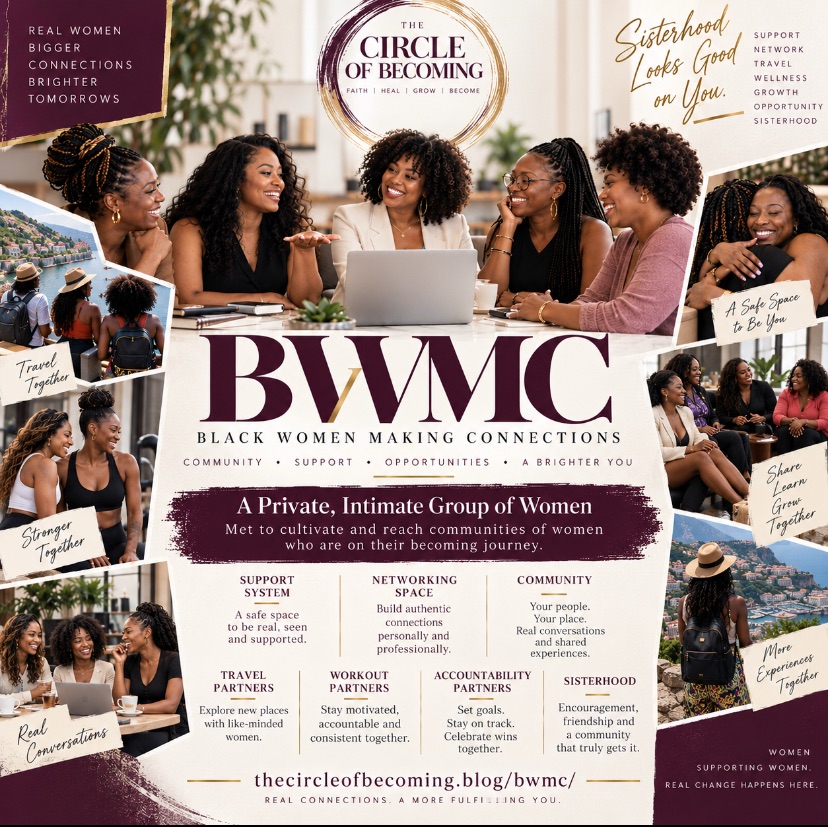
If this resonated with you, you’re in the right place. The Circle of Becoming is a space built for women who are tired of surviving and ready to start healing. Join the community and let’s do this work together.



Leave a Reply